Let's get the number out of the way first, because that's what you actually opened this page for.
Interior designer salary in India for 2026 sits somewhere between ₹2.5 LPA and ₹4.6 LPA for most working designers , that's the range where the bulk of the profession actually lives. Freshers start around ₹15,000 to ₹25,000 a month. Cross into mid-level and you're looking at ₹35,000 to ₹70,000 monthly. Senior designers with a decade behind them can pull in ₹1 lakh to ₹1.5 lakh a month, sometimes more if they're running their own studio or working luxury residential.
That's the headline. Everything else in this piece is about why your number might land nowhere near the average , because averages are almost useless once you factor in city, specialization, and whether you're on someone's payroll or hustling for your own clients.
Salary by Experience Level
Interior design pays in jumps, not a smooth line. You don't get a small raise every year like a lot of corporate jobs , you plateau for a while, then something (a promotion, a big project, going independent) moves you up a bracket all at once.
Entry-level / Fresher
If you're fresh out of a diploma or degree program, your interior design salary for freshers realistically lands between ₹15,000 and ₹25,000 a month. That's ₹1.8 LPA to ₹3 LPA annually, and yes, it feels low against the effort you put into four years of a B.Des. Everyone feels that at the start.
The variation here comes down to two things: which city you're in, and whether you've got a portfolio that actually shows real project work versus college assignments. A fresher who interned at a working studio and can show finished drawings, site photos, material boards , that person starts at the top of the range, not the bottom.
Mid-level (2–5 years)
This is where things get interesting. Once you've got a few years in and you're handling clients on your own , not just executing someone else's brief , pay moves to ₹35,000 to ₹70,000 a month, or roughly ₹5 LPA to ₹10 LPA a year.
What actually pushes you up within this band isn't years alone. It's whether you can run a project end to end: manage a budget, coordinate with contractors, keep a client calm when the tile delivery is three weeks late. Design skill gets you in the door. Project management keeps you employed and paid well.
Senior / Principal Designer
Ten-plus years in, and you're either heading a team at a firm or you've gone independent. Senior interior designer salary in India at this stage runs ₹1 lakh to ₹1.5 lakh a month for salaried roles , ₹12 LPA to ₹18 LPA. Principal designers or studio owners with a strong reputation can push past ₹20 LPA, and the data gets patchy above that because most people at this level aren't filling out salary surveys anymore. They're too busy running their practice.
| Experience Level | Monthly Range | Annual Range |
| Fresher (0–1 yr) | ₹15,000 – ₹25,000 | ₹1.8L – ₹3L |
| Mid-level (2–5 yrs) | ₹35,000 – ₹70,000 | ₹5L – ₹10L |
| Senior (6–10 yrs) | ₹80,000 – ₹1.5L | ₹10L – ₹18L |
| Principal / Studio Owner (10+ yrs) | ₹1.5L – ₹2.5L+ | ₹18L – ₹30L+ |
Also read: Career Guide to Becoming an Interior Designer if you're still mapping out how these stages actually connect year to year.
Salary by Employment Type
Where you work changes the math almost as much as how long you've worked.
Studio / Firm Employee
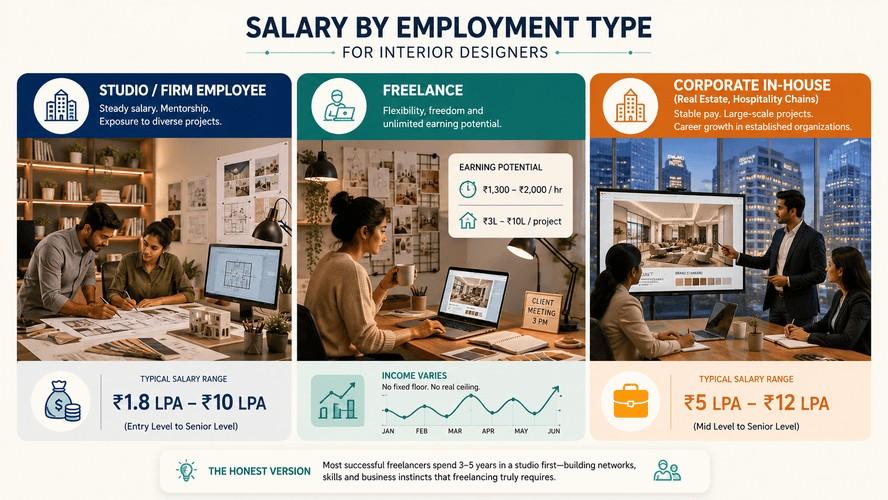
Working for an architecture or interior design firm gets you a steady monthly paycheck, mentorship, and exposure to a variety of project types you wouldn't see on your own early on. The trade-off is a ceiling , your firm's fee structure and hierarchy decide your growth pace, not just your talent. Studio salaries typically run ₹1.8 LPA at entry up to ₹10 LPA for someone senior managing multiple projects.
Also Read : How to Build a Stunning Interior Design Portfolio in 2026
Freelance
Freelance interior designer salary has no fixed floor and no real ceiling. Design consultants commonly charge ₹1,300 to ₹2,000 an hour, and independent one- or two-person practices bill ₹3 lakh to ₹10 lakh per residential project. Experienced freelancers handling premium work can clear ₹50,000 to ₹2 lakh a month , some months. Other months look thin, because client flow isn't guaranteed the way a salary is.
The honest version: nearly every freelancer doing well spent three to five years at a studio first, building the network and business instincts that freelancing actually needs. Going straight from college to freelance usually means underbidding to get any work at all, and burning out trying to be the designer, project manager, and accountant simultaneously. If you're weighing this decision seriously, it's worth reading through choosing between freelance and studio work before you commit either way.
Corporate In-house (Real Estate, Hospitality Chains)
Real estate developers, hotel chains, and corporate real estate firms increasingly keep interior designers on staff rather than contracting everything out. These roles pay competitively , often ₹5 LPA to ₹12 LPA at mid-level , because the work is tied to large, ongoing portfolios rather than one-off residential jobs. The trade-off is less creative range; you're designing within a brand standard, not your own vision.
Want to reach higher salary brackets faster? Kaarwan's Interior Design Certification helps you build industry-ready portfolios, master in-demand design software, and gain practical project experience that employers look for during hiring.
Salary by City
Interior design is a local business in a way a lot of other careers aren't. Your clients, your rates, your project sizes , all of it is shaped by the city you're in. Interior designer salary by city varies more than almost any other single factor.
| City | Mid-Level Monthly Range | Notes |
| Mumbai | ₹40,000 – ₹90,000 | Highest concentration of luxury residential and premium commercial fit-outs |
| Bangalore | ₹35,000 – ₹65,000 | Tech-sector offices and a fast-growing residential market |
| Delhi NCR | ₹40,000 – ₹75,000 | Gurgaon's corporate sector, South Delhi's luxury residential segment |
| Pune, Hyderabad, Chennai | ₹25,000 – ₹50,000 | Lower than metros, but cost of living is lower too |
| Tier-2 (Jaipur, Ahmedabad, Kochi) | ₹12,000 – ₹20,000 starting | Less competition, designers often go independent faster |
Interior design salary in Mumbai stays ahead of every other market for one simple reason , that's where the money in real estate concentrates. Interior design salary in Bangalore has climbed fast too, mostly off the back of tech-company office design and a residential boom that shows no sign of slowing. According to salary data from AmbitionBox, based on over 14,000 reported salaries, Bengaluru and Mumbai currently show near-identical average annual pay for interior designers, with Gurugram and New Delhi edging slightly ahead at the top end.
Here's a genuinely underrated point: a freelancer in a tier-2 city with five years of experience can sometimes out-earn a salaried designer in Mumbai at the same level, simply because competition is thinner and clients are more open to working with younger, less established names.
Interior Design vs Interior Styling , Pay Difference
This is where a lot of students get confused, and it's worth untangling because the two careers pay differently and want different skill sets.
An interior designer works on the bones of a space , layout, structural coordination, materials, lighting plans, contractor management. An interior stylist works on how a finished space presents , furniture arrangement, accessories, the visual composition you'd see in a photograph or a shoot. Interior stylist salary in India tends to start a notch lower than design roles, around ₹3 LPA to ₹5 LPA, climbing to ₹5 LPA to ₹9 LPA with two to three years and a decent portfolio. Established freelance stylists with a recognizable aesthetic can hit ₹8 LPA to ₹15 LPA, plus per-project fees for shoots and luxury residential styling that run ₹50,000 to ₹3 lakh a project.
Neither path is "better" , they just monetize differently. Designers get paid for solving problems clients don't see (plumbing runs, load-bearing walls, budget math). Stylists get paid for the part clients do see and post online. If you're trying to figure out which one actually fits you, interior stylist roles and requirements is a good next read, and interior design or architecture is useful if you're not even sure design is the right lane yet.
Also explore: interior styling as a related career path , it covers how the styling side of the industry is growing separately from traditional design roles.
What Increases Your Earning Potential
Salary charts tell you the range. They don't tell you why one designer sits at the top of a bracket and another sits at the bottom with the same number of years behind them. A few things actually move the needle:
Software fluency. AutoCAD and SketchUp are baseline expectations now, not differentiators. Designers who also know 3ds Max for rendering or Revit for BIM work command a real premium, especially on commercial and large-scale projects.
Specialization. Commercial and hospitality design pay noticeably more than generalist residential work at the same experience level , often 20 to 35% higher, because project budgets are bigger and the client relationships are longer-term.
Portfolio strength. In this field, your portfolio functions as your resume in a way a CV never will. Six to eight well-documented projects , before-and-after shots, technical drawings, material selections , will get you further in an interview than a degree certificate alone.
Certification. A structured, industry-relevant certification signals to employers that you've moved past theory and into applied skill, which matters a lot when you're trying to jump brackets early. If you're serious about closing that gap faster, Kaarwan's Interior Design Certification course is built exactly for that.
Site knowledge. Understanding how things actually get built , plumbing runs, electrical layouts, flooring substructures , separates designers who move up quickly from ones who plateau doing renders at a desk. It sounds unglamorous. It's also one of the fastest ways to earn a project manager's trust.
Thinking about upskilling to move into the higher-paying brackets sooner? Kaarwan's Interior Design Certification helps you build the portfolio and software skills employers actually screen for.
Conclusion
The number that matters isn't the industry average , it's the number that shows up for someone with your city, your specialization, and your portfolio. Interior designer salary in India rewards designers who treat the first few years as a training ground, not a payday, and who build the technical and client-facing skills that actually justify a higher rate. The market's growing fast enough that being genuinely well-prepared, more than being lucky with your first job, is what decides where you land on this chart five years from now.
FAQ
Is interior design a good-paying career in India?
Yes, with a caveat , the early years pay modestly (₹1.8 LPA to ₹3 LPA), but growth is steep once you cross three to five years and start handling projects independently. Designers who specialize or build a strong portfolio see their pay climb faster than the industry average.
Do interior designers need a degree to earn well?
Not strictly. A diploma gets you in the door, and a B.Des or M.Des accelerates access to senior roles. What actually determines pay is your portfolio and software skills , a diploma holder with strong real-project experience regularly out-earns a degree holder with a weak portfolio.
How much do freelance interior designers make?
Freelance interior designer salary varies widely , anywhere from ₹30,000 to ₹2 lakh or more per project depending on scope and city. There's no fixed floor, and income isn't steady month to month, which is the real trade-off against a salaried role.
What's the salary difference between interior design and interior styling?
Interior stylist salary in India typically starts slightly lower than design roles (₹3–5 LPA vs ₹2.5–4.5 LPA, roughly comparable at entry, but design roles often scale faster into six-figure monthly pay at senior levels because the work involves higher-stakes technical and budget responsibility).